
Simon Willison gave Opus 5.5 a blunt instruction: make his strategy game far more fun. The model spent 12 hours playtesting and rebalancing, and the game became engaging.
Game design is a long chain of calls about what to add, what to cut and what to rebalance. For those 12 hours, the model was making them.
The story comes from Three LLM Inflection Points in Twelve Months, adapted from his keynote. He names three steps: coding agents that became reliable in November 2025, Fable-class models in June and July 2026, and 3D and game work in September and October. He is still undecided whether Fable 5.2 is a fourth.
It is a useful map of when the machines could suddenly do more. I want to add one layer to it: what each step asks of a team’s decision boundaries.
His subject is what models can now do. Once they can, someone has to decide what they may do. That is where this post picks up.
Three steps, three boundary questions
Willison describes the capabilities. The questions that follow are mine: which call can change hands with each one?
November 2025: whether the output needs correcting. Before Opus 4.5, he had to correct Claude Code often enough that it did not feel reliable. With the new model, he says, “the default result was generally the right thing.” A default that is usually right changes what people bother to check. Accepting starts to do the work that deciding used to do. A team can ask which changes may now be accepted without a second look, and who agreed to that.
June and July 2026: how the problem gets solved. He describes Fable-class models as able to brute force a problem, given a goal and the right tools. In one of his examples, Fable built its own screenshot tooling and a logging server to chase a Safari glitch. The choice of method, including what to build along the way, moved to the model. A team can ask what the model may build, run or connect on its own while chasing a goal.
September and October 2026: what good looks like. Back to the game. Willison says Opus 5.5 was the first model he had used that seemed to understand fun. He still judged the result. Many of the calls on the way there were made inside the run. A team can ask which judgments about quality the model may settle, and which need a named person before release.
Read together, the three steps form a progression: from whether the output is correct, to how the goal should be achieved, to what makes a good outcome. Each step moves the model closer to decisions that have traditionally defined professional ownership.
When nobody redraws a boundary, it still moves. I call this silent escalation: a decision that needed more authority or context goes by default to whoever is closest. After a capability step, the closest party is often the model.
From one expert to a team
The work Willison describes is his own: his releases, his experiments, his game. When a decision moves from him to a model, his name is still on the outcome. An expert working alone can carry the boundary in his head, and his judgment of the result is the checkpoint. That can work well.
Now picture a team that gets the same model on the same day. One engineer stops reading diffs for routine changes. Another lets the agent pick the library. A product manager accepts its ranking of the backlog. Each move can be reasonable. If none is recorded, nobody can say where the boundary now sits. An unexamined delegation creates judgment debt: a cost that stays invisible until a decision has to be explained, reversed or defended.
The capability step comes first. Without it, there would be nothing to redraw. A model release can tell you what the machine is able to do. Your team still has to say who has agreed to let it.
What to do at the next step
Willison is still deciding whether Fable 5.2 is a new step. A team can act without that verdict. When your team adopts a new model, reopen the boundaries where consequence is high, and ask three questions:
- Since the last model, what have people stopped deciding or checking, and what have they newly delegated, including work nobody did before?
- For each of those, can it be reversed, at what cost, and does the effect outlast the sprint?
- Whose name is on it now?
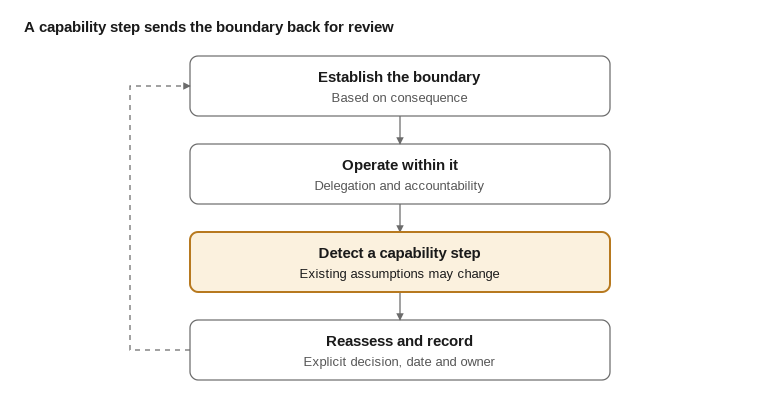
Write the answers in the judgment log, with a date and an owner. “Nothing moves” is a valid entry. Leave routine, reversible work alone.
My earlier post on decision boundaries said to draw them by consequence. My book adds that the boundary map is revised when the system or the risk changes. A capability step is a clear reason to check whether either one has.
That makes a boundary something a team maintains, in a loop.
Willison put dates on the moments when the machine could do more. Put a date on your answer to each one, and a name.