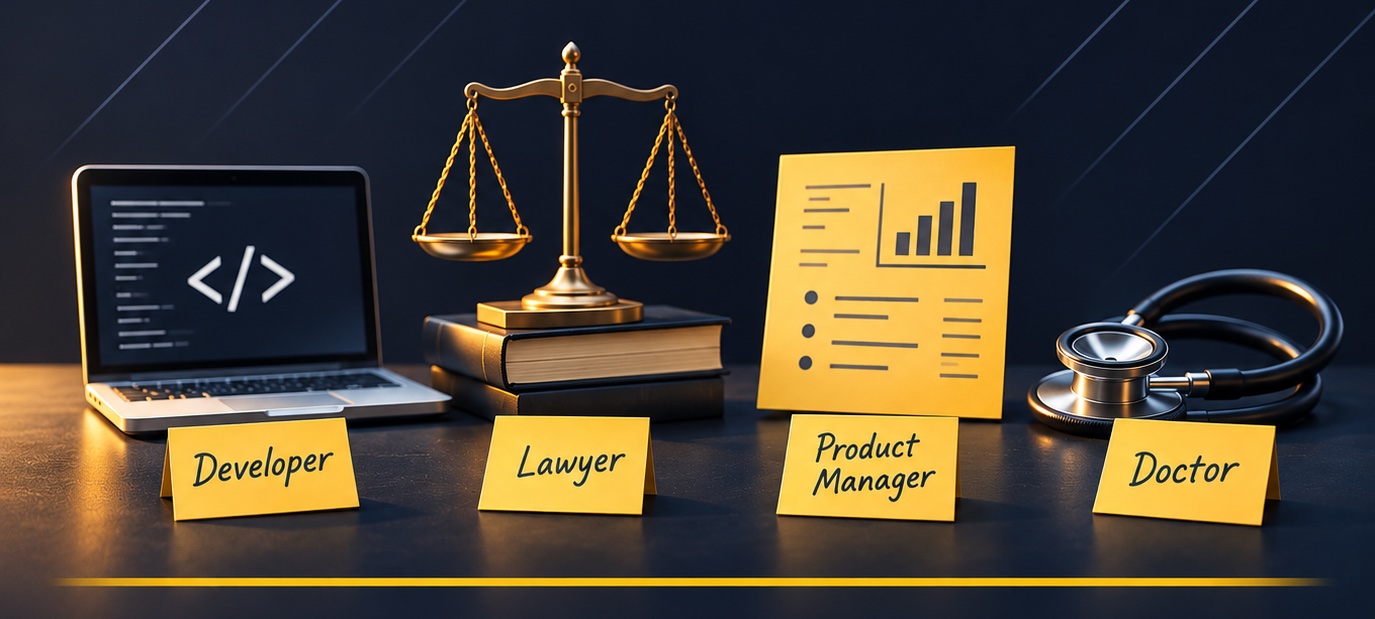
Developers use AI to write code. Lawyers use it to analyze cases and draft filings. Product managers use it to size markets and write specs. Doctors use it to read test results. So are they still developers, lawyers, product managers and doctors?
The question keeps getting asked because it feels like a question about tools. It is actually a question about where a profession lives.
What the profession was never about
For a long time, execution and professionalism came bundled. The person who could write the code, draft the brief, produce the spec or read the scan was the professional, because doing it was slow and hard. Skill at execution was the visible proof of something underneath.
That something is deciding what should be done, and answering for it. A developer ships code that other people must live with. A lawyer signs the filing. A doctor puts a name on the diagnosis. A product manager commits the roadmap. Execution was the part you could see. Accountability was the part that made it a profession.
As execution gets cheap, the bundle comes apart. Professionalism has moved from the execution itself to the decision, and to the accountability for the final product.
What AI takes and what it leaves
Look at what the tool actually replaces in each job.
- Developers. AI takes the typing: boilerplate, tests, the first draft of a function. It leaves what to build, which tradeoff to accept, and whether this change is safe to ship.
- Lawyers. AI takes the first pass through the documents and the first draft of a clause. It leaves the theory of the case, the risk the client can live with, and the signature.
- Product managers. AI takes the market summary and the first draft of the spec. It leaves what to bet on, what to cut, and who has to live with the result.
- Doctors. AI takes pattern recognition across results and scans. It leaves the person in the room, the weighing of risk against what this patient wants, and a diagnosis with a name on it.
In each case, what goes is repeatable. What stays is a call that someone must own.
Where the line actually is
Two professionals can open the same AI tool, get the same output, and be doing different jobs.
The first treats the tool as a capable partner under direction. They set the question, challenge the answer, reject what does not hold, choose, and put their name on the result knowing why. The second accepts what looks plausible and moves on. Fire and forget.
The tool is identical. What differs is who is accountable. In Judgment-Driven Development (JDD), judgment is defined as the willingness to take accountability for a decision made under uncertainty. The accountability is the entire content of the term. A choice with no name attached is a preference, stated confidently.
The drift
Few people choose the second mode on purpose. They drift into it. When producing is nearly free and checking is not, the reasoning step costs more than the accepting step, and nothing in the system pays the difference. Under deadline, accepting wins.
Do that often enough and you accumulate judgment debt: the cost of a skipped checkpoint, invisible until it comes due. It arrives as a bug in production, a clause nobody read, a market size nobody tested, a result nobody questioned.
The quieter failure is silent escalation. A decision that belonged to someone with more authority or context gets made by default, by whoever was closest. Increasingly, that is whoever clicked accept.
The objection: what if the AI is simply better?
Sometimes it will be. A model may read a scan more consistently than a tired radiologist, or find the missing clause faster than a junior associate. That does not move the accountability.
Better on average is a statement about a population. Accountability attaches to the case in front of you. Someone has to notice when this case sits outside the average: the unusual patient, the contract with an odd counterparty, the feature that touches a regulated customer. Noticing takes judgment, and judgment needs a person who is still paying attention.
There is a practical limit too. When a tool is right most of the time, the human check gets thinner, and the rare failure arrives exactly when nobody is looking. The more reliable the tool, the more deliberate the checkpoint has to be.
A test you can use today
Before you sign off on anything AI helped produce, ask three questions.
- Could I explain why I chose this and not the alternative?
- Do I know what I rejected, and why?
- If this is wrong, whose name is on it?
If the answer to the third is “mine” and the first two are “no”, you are not sitting in the professional’s seat. You are a pass-through.
What organizations should do
Do not review everything. That recreates the friction AI removed, and people route around it. Concentrate judgment where consequence changes: decide which calls are irreversible, name the owner of each, and keep a judgment log, a record written at the moment of the decision by the person accountable. A year later, the rejected alternative and the stated confidence are the two fields you will wish you had.
The most useful artifact is a map of decision boundaries: what a person or an agent may decide alone, what needs a named human, and what needs more than one. Draw it before the tool is in daily use, not after the first incident. It turns “the AI did it” from an excuse into a design question.
The point
AI did not make these professions obsolete. It made it obvious what they were. The professionals who remain professionals will be the ones who can say, about any output, “I decided this, and here is why.”