AI made execution cheap. It did not make judgment cheap.
A working prototype now takes an afternoon. A feature that once needed a team for a sprint can be generated before lunch. But somebody still has to decide what to build, whether it is right, and who answers for it when it goes wrong. For decades, slow execution did much of that judgment work by accident. That friction is gone, and in many teams nothing has replaced it.
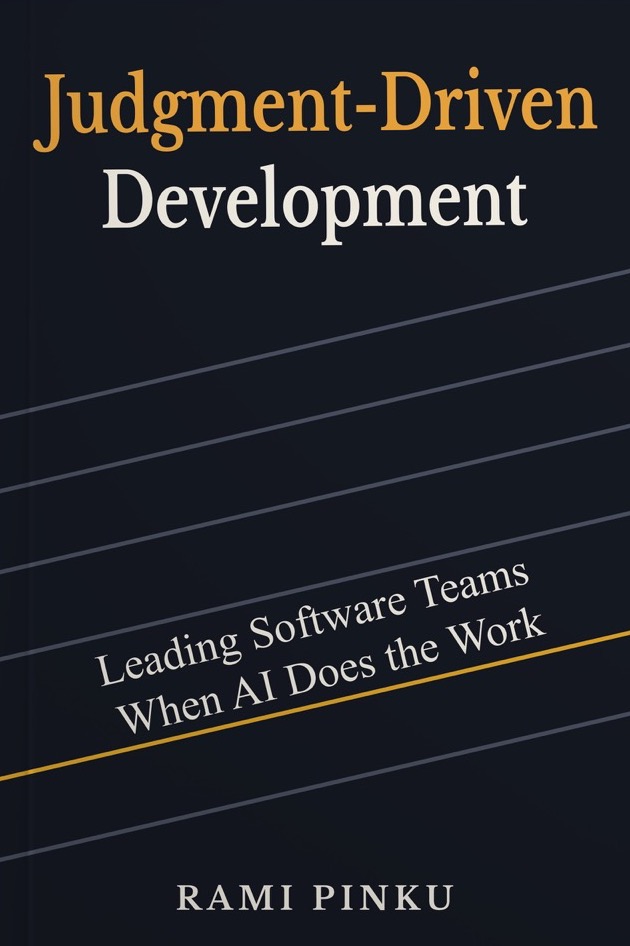
Judgment-Driven Development is an operating model for software teams that work with AI. It gives judgment a structure: a cycle with a checkpoint at every stage, decision boundaries that match authority to consequence for people and AI agents alike, and a record of why decisions were made that the next person or agent can actually use.
Get the book on Amazon (paperback and Kindle)
What is inside
- Why AI compressed every stage of software delivery except the decisions between them
- How to draw decision boundaries for people and AI agents, and enforce them where the action happens
- How to keep a Judgment Log that survives delivery pressure
- What changes for product managers, senior engineers, and juniors who no longer learn by doing the grunt work
- How to measure, hire, and manage for judgment without turning it into a performance score
- How to protect all of this when the deadline arrives
The book ends with a step-by-step roadmap for running JDD in one team for one quarter, with checklists at each stage.
Who it is for
Engineering leaders, product managers, and executives who have to decide what AI should decide.
Where it came from
Much of the thinking behind the book was worked out in public, here on this site. If you want to see how the ideas developed, start with the JDD essays.
Tried it? Tell me
If you try JDD, in a team or on your own, I want to hear what happened. Send it to rami@newrealm.co with “JDD report” in the subject line. It does not need to be polished, and it does not need to be a success story. A trial that failed, with an account of why, teaches more than one that went smoothly. What I learn will go into the next edition.