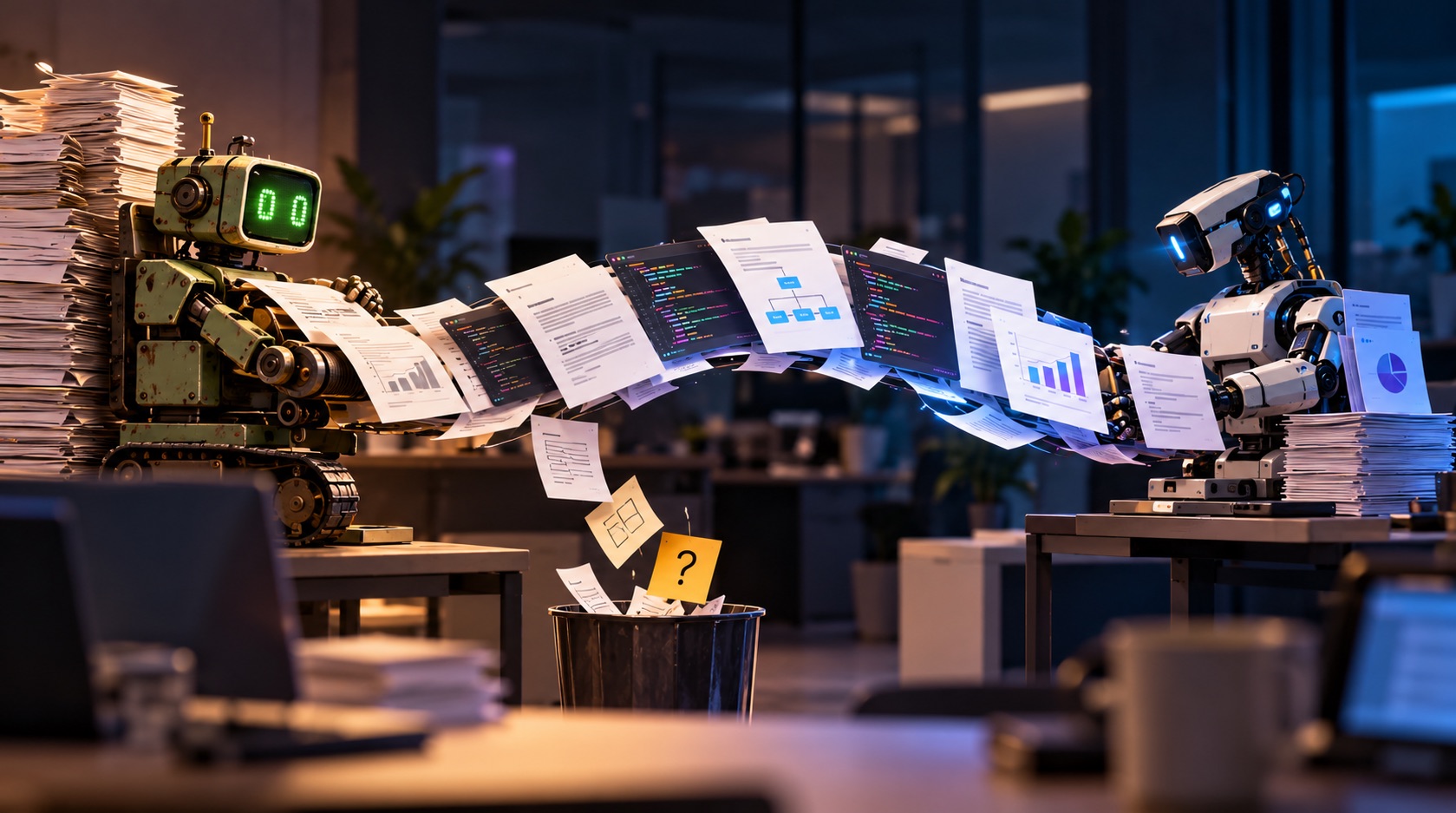
The future of work, where everyone is productive and nobody knows what’s going on.
I recently came across a brilliant comedy clip by Deepak Chandran about how we use AI to write emails.
Someone has a simple message. They give it to AI, which turns it into a beautifully structured, professionally worded, eighteen-page document.
The recipient can’t be bothered to read it, so they ask AI to summarize it.
We’ve built a remarkably sophisticated machine for turning one sentence into eighteen pages and back into one sentence.
And we call it productivity.
The Joke Gets Less Funny Outside the Inbox
A product manager asks AI for a detailed requirements document. Engineering feeds it into another AI to extract what actually needs building.
A coding agent writes thousands of lines of code. A review agent finds the problems and generates fixes. A third agent summarizes what was built, and a fourth turns the summary into a deck for management.
Somewhere around step two, “users can export their data” quietly became “users can export data.” Nobody noticed, because every document along the way was beautifully formatted. Three sprints later, a customer downloads someone else’s invoices. Every step was reasonable. Every output was polished. The release notes called it “enhanced data portability.”
Everyone is busy. Everyone is shipping. Everyone is moving incredibly fast.
How many people along that chain understood what they were building? And how many would have recognized when something went wrong?
Let’s Eliminate the Middleman
If this is where we’re heading, why keep the humans in the loop at all?
Let your agent talk to my agent.
They can exchange requirements, negotiate priorities, write specs, build, review, test, and report back that everything is wonderful. We’ll lose a few meetings along the way, and nobody will mourn them.
Then the agents can hold a retro, agree that communication was excellent, and congratulate each other on another successful delivery.
And one day, someone might actually try to use what we built.
Producing Is Not Understanding
AI can do excellent work. Agents talking directly can remove enormous amounts of pointless coordination. Fine by me.
What worries me is that we’re confusing producing something with understanding it.
We can delegate writing. We can delegate analysis. We can delegate implementation. But when we delegate understanding too, we lose the ability to tell whether the result makes any sense.
The danger isn’t that AI produces garbage. It’s that it produces something convincing enough that nobody bothers to find out.
Every handoff in that chain is a decision. Is this the right requirement? Does this code do what we meant? Does this summary describe what we actually built? AI can produce an answer at every step. Someone still has to own whether it’s the right one.
This is the core idea behind Judgment-Driven Development (JDD). When execution becomes cheap, judgment becomes the scarce resource, and it deserves the same deliberate design we used to reserve for code. In practice, that comes down to three things:
- Decision boundaries. Decide upfront which calls an agent can make on its own and which need a human who understands the context. “Export their data” versus “export data” is not a formatting preference.
- Named owners. Every handoff has a person accountable for whether the output is right, not just whether it exists.
- A judgment log. Record what was decided, by whom, and why. Not eighteen pages. A few lines a human will actually read, so that when something breaks, you can trace it to a decision instead of a vibe.
None of this slows the agents down. It just means that when they talk to each other, someone is still listening.
Because when things go wrong, every agent will have a perfectly reasonable explanation for what it did. Detailed. Well structured. Eighteen pages, probably.
There just won’t be anyone left who understands how we got there.
Let your agent talk to my agent.
Just make sure at least one of us still knows what we asked for.
Sources