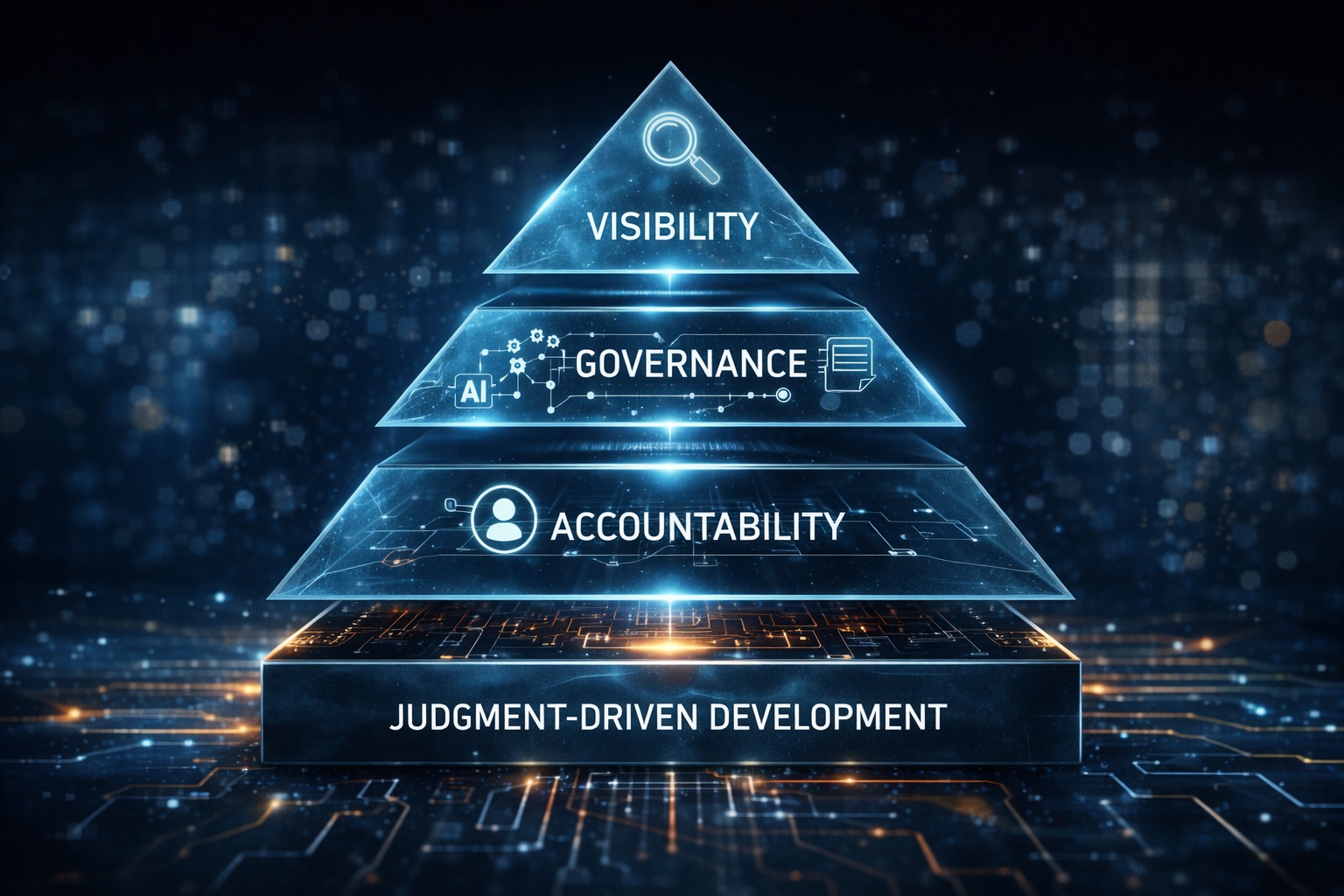
I recently argued on the JFrog blog that trusted AI requires more than model quality. It requires visibility, provenance, governance, and a real system of control around the things models consume, build, and ship.
That is the foundation.
This post is about what you build on top of it.
Because visibility is necessary. Without it, you cannot govern anything. If you cannot see which models are running, where they came from, how they behave, and what they touch, you do not have a governance posture. You have hope dressed up as architecture.
But visibility alone is not sufficient.
You can have complete observability and still have no governance. Because governance is not the act of seeing. It is the act of deciding, and making someone accountable for the decision.
That is where most organizations are weaker than they realize.
The problem visibility alone cannot solve
Enterprise AI governance is often framed as a visibility problem.
Which models are in use. Where they came from. What data touched them. What tools they can access. Who approved them.
Get all of that right and you have the infrastructure for governance. What you do not yet have is governance itself.
The real problem is that AI lets organizations create and connect things faster than their judgment systems can govern them. Visibility tells you what is happening. It does not tell you who is responsible for it, whether it was sanctioned, or what should have been allowed in the first place.
The failure starts before the missing audit trail. Before the unapproved model in production. Before the agent with too much access. It starts when nobody has made explicit who owns the decision, who owns the risk, and who is accountable for the consequences.
You cannot govern what nobody owns.
Execution got cheap. Accountability did not.
This is the central shift behind Judgment-Driven Development.
AI has dramatically reduced the cost of execution. It is easier than ever to generate artifacts, write code, connect services, create agents, and ship internal workflows that look useful enough to deploy.
That sounds like pure upside. It is not.
Because the reduction in execution cost does not reduce the cost of being wrong. It does not reduce the cost of bad judgment. It does not reduce the cost of unclear accountability. If anything, AI makes those failures more dangerous, because it allows organizations to scale them faster.
The bottleneck is no longer only whether your teams can build. The bottleneck is whether your organization can make good decisions about what should be built, what should be allowed, and who is responsible when something goes wrong.
Most organizations are optimizing hard for the first problem and leaving the second one to chance.
Visibility enables judgment. It does not replace it.
In JDD terms, traceability is the prerequisite for exercising judgment, not a substitute for it.
You cannot evaluate a decision you cannot see. You cannot enforce a policy against a model you did not know existed. You cannot hold anyone accountable for a risk that was never visible. The case I made for a governed system of record around models, agents, MCP servers, and AI-generated artifacts is exactly right: without that foundation, judgment has nothing to operate on.
But once you have visibility, the harder question begins.
Why was that decision acceptable in the first place? Was the tradeoff explicit? Did anyone with authority evaluate it? Was the decision owned by the people best positioned to understand the consequences?
A traceable bad decision is still a bad decision. A fully auditable mistake is still a mistake. Visibility surfaces what happened. Judgment determines what should have been allowed to happen. Both are required. Neither replaces the other.
The real problem is shadow ownership
We talk a lot about shadow AI. Unapproved tools, unknown models, teams doing things outside standard controls.
Visibility solves that problem directly. Once you can see it, you can govern it.
But there is a harder problem that visibility does not solve: shadow ownership.
Shadow ownership is when everyone is involved but nobody is clearly accountable. Security owns policy but not product intent. Product owns the use case but not runtime controls. Engineering owns implementation but not organizational risk. Leadership wants speed but avoids making tradeoff decisions explicit.
So work keeps moving. Everyone assumes someone else owns the hard calls.
In JDD, this is the failure mode the judgment layer is designed to prevent. The judgment layer is not a committee or an approval form. It is the explicit, owned act of deciding what the system is and is not allowed to do, before it does it. You need visibility to enforce the judgment layer. But visibility without the judgment layer is just a dashboard showing you things nobody has decided how to govern.
Agents make this unavoidable
The shift becomes impossible to ignore once you move from AI generating outputs to AI taking actions.
Agents are only as trustworthy as what they consume, build, and ship. That supply-chain view is correct and necessary. What it surfaces is the ownership question underneath: someone has to decide what the agent is allowed to consume, build, and ship, and that someone has to be accountable when the boundary is wrong.
In JDD, this is delegated judgment. You are not just giving a system access. You are delegating a decision right to it. Delegated judgment requires two things: visibility into what the agent is doing, and explicit ownership of what it is allowed to do.
Without visibility, you cannot see when the boundary is violated. Without ownership, you have no boundary to enforce in the first place. Both layers are load-bearing.
Governance is not a layer you add at the end
A lot of teams still treat governance as something you apply after the exciting part. First build. Then test. Then figure out controls. Then ask security.
That worked poorly even before AI. With AI, it breaks faster.
In JDD terms, governance is applied organizational judgment. Policies are judgment encoded. Approval models are judgment encoded. Runtime constraints are judgment encoded. The visibility infrastructure makes that encoding enforceable. But someone has to do the encoding first.
That means making a few things explicit early: who is allowed to introduce a new model, agent, or tool; who approves exceptions; what risks are acceptable in which contexts; who owns runtime behavior, not just initial deployment; how escalation works when the answer is uncertain.
Those are not administrative details. They are the operating model. Visibility without them is observation. With them, it becomes governance.
The uncomfortable truth
Many organizations do not have an AI governance problem because they lack tooling or visibility.
They have an AI governance problem because they have not decided how judgment should work under conditions of dramatically accelerated execution.
Visibility is a necessary step. You cannot enforce a policy against a model you cannot see. You cannot hold anyone accountable for a risk that was never surfaced. Getting visibility right is not optional, it is the prerequisite for everything that follows.
But it is still a prerequisite, not the destination.
The harder work begins once you can see clearly: deciding who owns what, what risks are acceptable, who can say yes and who can say no. That work is less legible than building a dashboard. It does not ship on a sprint. It does not show up in a vendor demo.
It shows up when something goes wrong and the organization can, or cannot, answer the question: who decided this was acceptable?
Final thought
The infrastructure for visibility, traceability, provenance, a governed system of record around AI systems and their supply chain, is load-bearing. You need it. I stand behind that argument.
But visibility is the floor, not the ceiling.
The ceiling is an organization where ownership is explicit, decision rights are explicit, risk tolerances are explicit, and escalation paths are clear. Where people know who can say yes and who can say no. Where the systems running in production are bounded by decisions that were made deliberately, by people who were accountable for making them.
Visibility makes that possible. Judgment makes it real.
As AI systems become more autonomous, that judgment does not disappear. It moves upstream, becomes less visible, and becomes more consequential.
The organizations building both layers now are the ones that will still be in control when the next level of autonomy arrives.
You cannot govern what nobody owns.