Something broke in the last two years.
The pace of change in AI alone has reached a frequency that no person can track without a system: new models, new frameworks, new paradigms, new competitive moves. Add to that the normal demands of a senior role: strategy documents, stakeholder alignment, product decisions, customer conversations. Add personal projects. Add family. Add the nagging sense that something important happened while you were handling something else.
Everyone I know in tech is carrying more than they used to. And it is not just tech. Anyone juggling professional responsibilities alongside a personal life, side projects, and the relentless need to stay current feels it. The context switches are constant. The lists keep growing. The week ends and you are not quite sure what you actually moved forward.
The irony is that the same technology creating the overload is also the thing that can help manage it, if you build the right interface between yourself and the noise.
I decided to stop managing it manually. Instead, I built a small team of agents.
The Problem
The problem is not lack of information. The problem is that information lives in too many places and none of them talk to each other.
Your notes have your thinking. Your calendar has your commitments. Your inbox has signals from the outside world: newsletters, industry news, things people send you. Your work projects are pulling in one direction, your personal goals in another, and somewhere in between you are supposed to have a coherent view of where you are and where you are going.
The cognitive overhead of maintaining that view manually is significant. Every Monday morning most people spend 30-40 minutes just reconstructing context: what did I work on last week, what is coming up, what did I mean to follow up on. That is not thinking. That is retrieval. And retrieval is exactly what agents are for.
The Solution: A Small Team of Agents
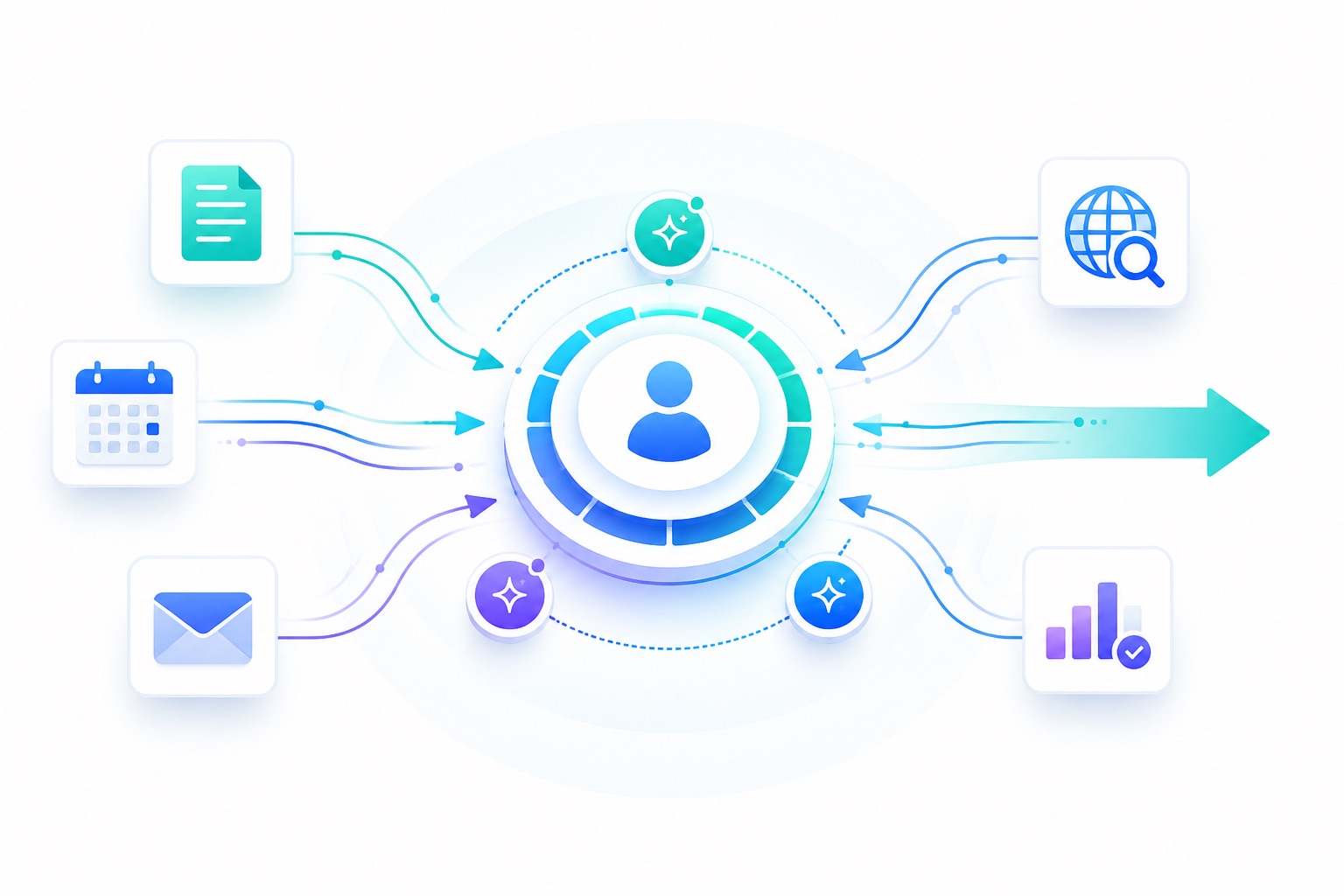
Three agents. Each has a single job. Together they cover the full loop: inside context, outside signals, and weekly rhythm.
Agent 1: Daily Digest
Runs at 1am. Reads yesterday’s Obsidian daily note and any vault files touched in the past 24 hours. Pulls tomorrow’s calendar. Synthesizes everything into a structured email that lands before you wake up.
Four sections: what you worked on yesterday, what files you touched, what is on tomorrow’s calendar, and suggested focus for the day. The last section is the one that matters most. It is grounded in what you were actually doing, not a generic priority framework.
It reads the inside world so you wake up with context already loaded.
Agent 2: Wiki Update
Runs at 11pm. Reads the entire vault, identifies active topics dynamically, runs web searches on each one, and publishes a private wiki to a secured site. Each topic page has two halves: what your notes say about it, and what the internet currently says about it.
Having a single place that combines your own thinking on a topic with current external developments is a qualitatively different kind of reference than either source alone. Your internal model meets the external world, updated every night.
It connects your thinking to what is happening in the field on every topic you are actively working on.
Agent 3: Weekly Review
Runs at the end of the work week. Reads the whole week’s daily notes and modified vault files. Pulls both this week’s and next week’s calendar. Produces a retrospective and a forward plan: what you actually accomplished, what is still open, what you should prioritize next week and why.
It also publishes a wiki page archiving each week’s review, so over time you have a searchable history of where your attention went.
It closes the week and opens the next one before you even think about it.
What You Actually Get
A morning email that already knows what you were working on yesterday and what is coming today. A private site that reflects your current thinking on every active topic, enriched with fresh external research. A weekly review grounded in what you actually did rather than what you intended to do.
More importantly: you get to spend your thinking time thinking, not retrieving.
The agents surface. You decide. That division of labor is the point.
The JDD Connection
JDD, Judgment-Driven Development, is the framework I’m building around a simple idea: as AI makes execution cheaper, human judgment becomes the scarce resource. The question is not whether to use AI but how to structure the human-AI interface so that judgment is exercised where it matters and retrieval is delegated where it does not.
This system is a direct implementation of that idea. The agents handle retrieval, synthesis, and routine summarization. You handle decisions, priorities, and the actual thinking that moves things forward. The wiki does not tell you what to think. It tells you what you have already thought and what is currently happening in the field, so you can think better.
Infrastructure for judgment, not a replacement for it.
Build It Yourself
All three agents are documented with full prompts and setup instructions. Everything runs on Cloudflare for the private wiki layer. No servers, no code, no maintenance overhead.
If you want to build your own version: Build Your Personal AI Brain