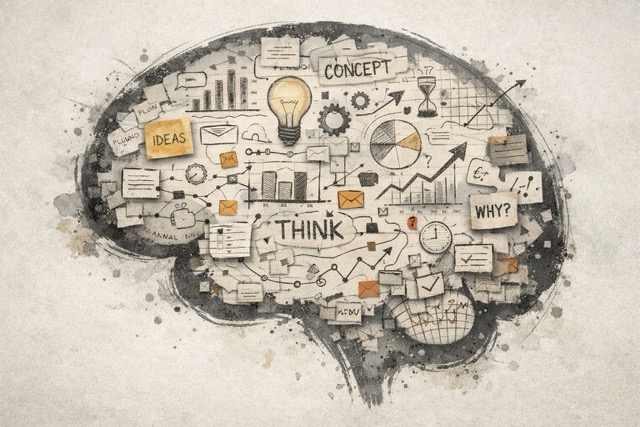
A Real Second Brain
The idea of a “second brain” is simple.
An external place to put thoughts, notes, ideas, and fragments of work, so your actual brain can focus on thinking and deciding instead of remembering.
In theory, this is how knowledge compounds instead of disappearing.
I have liked this idea for a long time.
It is why I used Microsoft OneNote for years, and later moved to Obsidian.
What I never liked was how much work these systems require in order to be useful.
To function as a proper second brain, you are expected to constantly maintain structure.
Tags. Links. Backlinks. Folders. Taxonomies.
If you stop doing that, the system slowly degrades.
At some point, the effort shifts.
Instead of the system supporting your thinking, your thinking starts to revolve around maintaining the system.
After years of working in environments with a lot of context switching, ambiguity, and incomplete information, this always felt wrong to me.
Thinking is not linear, and it is rarely clean.
The change for me did not come from better structure.
It came from removing the need for it.
Instead of trying to organize my Obsidian vault, I now use AI to extract value from it as it is.
The mess is not something to fix. It is the raw material.
I use it to:
- Find connections between notes I never linked
- Review to do lists and move completed items to archive
- Summarize the past week across tasks, notes, and random thoughts
- Surface action items that are implied but never written explicitly
- Gather and consolidate information on topics I am working on or researching
The important shift is this:
my notes do not need to be clean in order to be useful.
My brain dump can remain a brain dump.
And still, it produces summaries, context, and next steps.
That matters, especially now.
We live in a world of constant information flow and growing pressure to move fast.
Access to information is no longer the problem.
Making sense of it is.
For the first time, my “second brain” feels less like an archi