From CLS to Agentic AI
I was born in 1977, right at the intersection of two worlds.
Old enough to remember analog. Young enough to grow with digital.
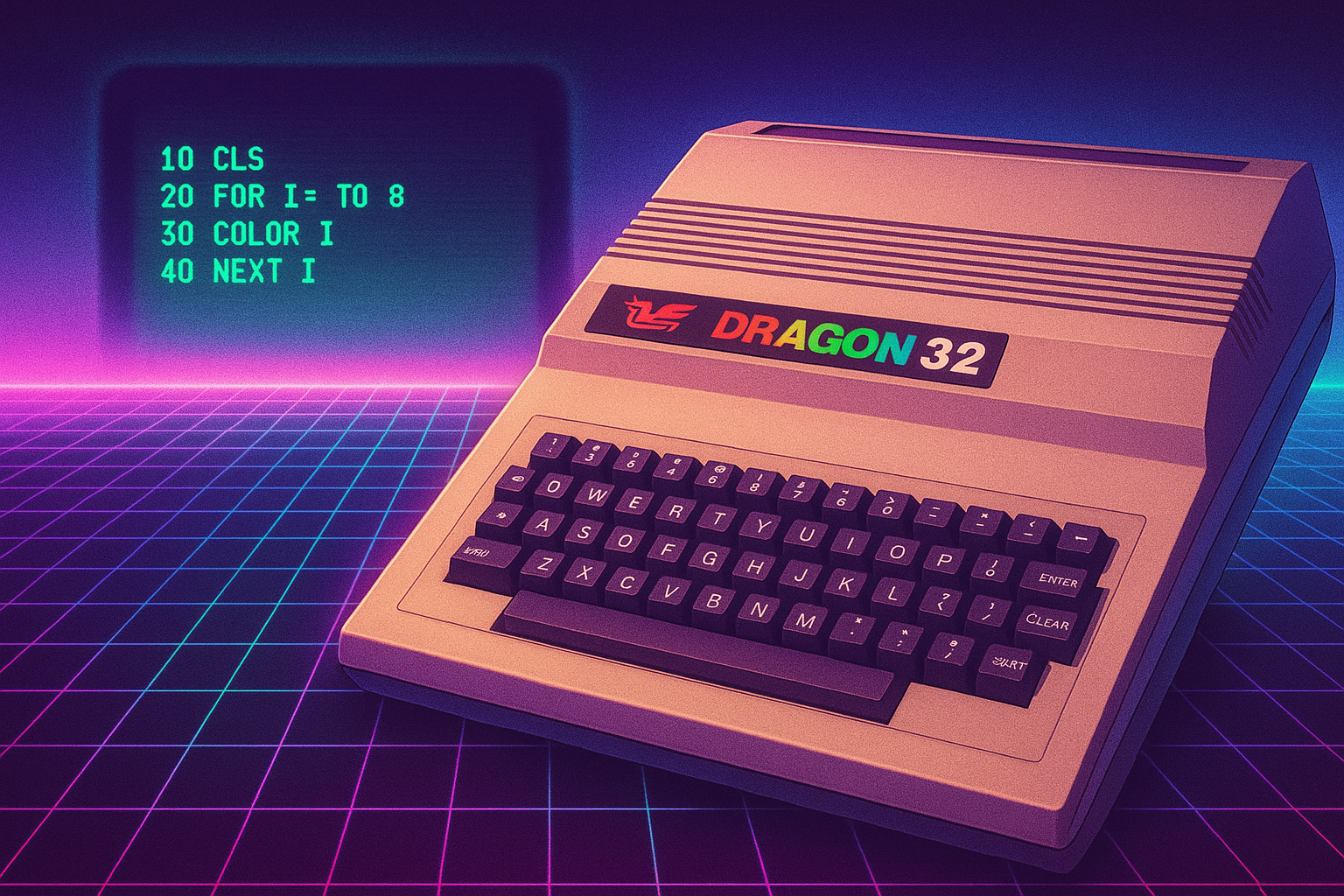
My first program was written on a Dragon 32, a home computer with 32 kilobytes of RAM and a keyboard that felt like it came from a typewriter factory. My oldest brother brought it home one afternoon, and it was the first computer I ever saw in real life.
I still remember connecting it to the TV.
Sitting on the floor, waiting for the screen to flicker on, and watching it boot straight into BASIC. A blinking cursor on a green screen, and a feeling of wonder I didn’t have words for.
I was seven years old, didn’t know a word of English, and had no idea what “READY” meant.
But the Dragon came with a small user manual, and I worked through it page by page. I didn’t understand the language, but I understood the logic. I understood that if I typed something, the machine would react.
The first code I ever wrote was a simple loop that used CLS to cycle through screen colors. It did nothing practical, but it opened a door that never closed.
Below is the recreated version of that first program:
Growing up in the eighties meant living through the most dramatic transition in modern history.
Everything was shifting, constantly.
Music moved from vinyl to cassettes, then to CDs, then to MP3s, and eventually to streaming. The internet grew from dial-up to broadband, then to fiber and always-connected mobile. Our home computers became smartphones, and our smartphones became AI systems that can reason, plan, and act.
Every few years, the interface changed, the assumptions changed, and the rules changed.
If you did not adapt, you stayed behind.
This wasn’t a skill we practiced deliberately.
It was survival.
Today, this same skill is the foundation of modern product leadership.
Technology no longer evolves gradually.
It jumps.
Gen AI arrives.
Then reasoning models.
Then function calling.
Then multi-agent systems.
Then MCP and agentic ecosystems.
By the time you finish exploring one wave, the next one is already redefining the stack.
You cannot go deep into everything.
There is not enough time and not enough cognitive bandwidth.
So you need clarity.
A filtering mechanism that cuts through noise immediately.
For every new technology, ask four questions:
- What is it
- What is it good for
- How can I use it
- How can others use it
This is the difference between chasing hype and building insight.
Modern product work is not about predicting everything.
It is about recognizing the shifts that actually change markets, reshape value chains, and influence your product roadmap.
The advantage my generation developed, the ability to rebuild mental models, discard obsolete assumptions, and adapt fast, is no longer optional.
It is the operating system for modern leadership.
The world will keep moving faster.
Our responsibility is to adapt fast enough to shape the part that matters.